
Navigating the complexities of debt can feel overwhelming, but understanding effective strategies empowers you to regain control of your finances. This guide provides a clear path towards debt reduction, focusing on practical methods and actionable steps. We’ll explore various debt types, assess your financial situation, and implement proven strategies for repayment.
From creating a realistic budget to understanding the nuances of debt snowball versus debt avalanche methods, we’ll equip you with the knowledge and tools necessary to navigate your financial journey confidently. We also delve into the importance of seeking professional help when needed and emphasize the crucial role of preventative measures to avoid future debt accumulation.
Debt Management Strategies
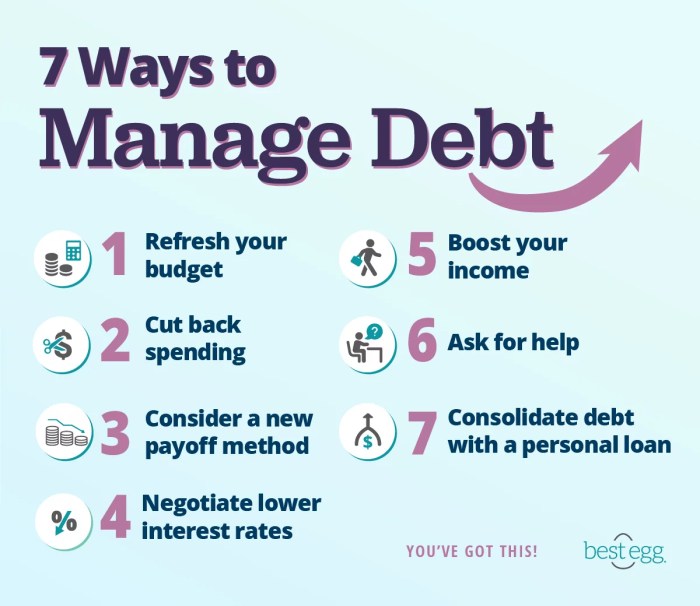
Effective debt management involves strategically prioritizing and repaying debts to minimize interest payments and achieve financial freedom. Understanding different repayment methods is crucial for tailoring a strategy to your specific financial situation.
Debt Repayment Methods: Debt Snowball vs. Debt Avalanche
Two popular debt repayment methods are the debt snowball and the debt avalanche methods. Both aim to eliminate debt, but they differ significantly in their approach. The debt snowball method prioritizes paying off the smallest debts first, regardless of interest rates, while the debt avalanche method prioritizes paying off the debts with the highest interest rates first.
Debt Snowball Method: Advantages and Disadvantages
The debt snowball method offers a powerful psychological advantage. Seeing smaller debts disappear quickly provides motivation and a sense of accomplishment, encouraging continued effort. This can be particularly beneficial for individuals who struggle with maintaining momentum in long-term financial goals. However, a disadvantage is that it may lead to paying more interest overall compared to the debt avalanche method, as higher-interest debts remain outstanding for longer.
This method is best suited for individuals who need the psychological boost to stay committed to their debt repayment plan.
Debt Avalanche Method: Advantages and Disadvantages
The debt avalanche method focuses on minimizing the total interest paid. By tackling the highest-interest debts first, you save money in the long run. This is mathematically the most efficient approach. However, the initial progress may feel slower, as the larger debts take longer to eliminate, potentially leading to discouragement. This method is ideal for individuals who are disciplined and prioritize minimizing long-term costs over short-term motivational gains.
Comparison of Debt Snowball and Debt Avalanche Methods
| Method | Pros | Cons | Suitability |
|---|---|---|---|
| Debt Snowball | Motivational, quick wins, builds momentum | May pay more interest overall, slower overall debt reduction | Individuals needing psychological reinforcement, those with multiple small debts |
| Debt Avalanche | Minimizes total interest paid, faster overall debt reduction | Can be demotivating initially, slower progress on smaller debts | Disciplined individuals prioritizing cost savings, those with high-interest debts |
Budgeting and Financial Planning
Effective budgeting and financial planning are crucial for successful debt management. A well-structured budget allows you to visualize your income and expenses, identify areas for savings, and allocate funds towards debt repayment. This proactive approach helps you gain control of your finances and accelerate your progress towards becoming debt-free.Creating a budget involves carefully tracking your income and expenses over a specific period, typically a month.
This process reveals spending patterns and highlights areas where adjustments can be made to free up more money for debt reduction. Combining budgeting with a clear financial plan, which Artikels short-term and long-term financial goals, provides a roadmap for achieving financial stability.
Sample Budget Incorporating Debt Repayment
A sample budget should reflect individual circumstances, but a general framework can be helpful. This example assumes a monthly net income of $3000. Remember to tailor this to your own income and expenses.
| Income | Amount |
|---|---|
| Net Monthly Income | $3000 |
| Expenses | Amount |
| Housing (Rent/Mortgage) | $1000 |
| Utilities (Electricity, Water, Gas) | $200 |
| Groceries | $400 |
| Transportation (Car Payment, Gas, Public Transport) | $300 |
| Debt Repayment (Minimum Payments + Extra) | $500 |
| Health Insurance | $200 |
| Other Expenses (Entertainment, Clothing, etc.) | $400 |
| Savings | $0 |
This budget allocates $500 towards debt repayment. Ideally, you should aim to allocate more towards debt repayment each month as your financial situation improves. The $0 allocated to savings demonstrates the importance of prioritizing debt repayment initially, but building savings should be a priority once debt is under control.
Budgeting Apps and Tools
Several budgeting apps and tools are available to simplify the budgeting process and track financial progress. These tools often offer features like automated expense tracking, budget categorization, and debt repayment planning.
- Mint: A popular free app that connects to your bank accounts and credit cards to automatically track your spending and provide insights into your financial habits.
- YNAB (You Need A Budget): A subscription-based app that emphasizes zero-based budgeting, where every dollar is assigned a purpose.
- Personal Capital: A free tool that provides a comprehensive overview of your finances, including investment accounts and retirement planning.
Setting Realistic Financial Goals and Tracking Progress
Setting realistic financial goals is essential for staying motivated and achieving long-term financial success. These goals should be specific, measurable, achievable, relevant, and time-bound (SMART).For example, a realistic goal might be to reduce your credit card debt by 20% within six months. Regularly tracking your progress towards these goals is crucial. This can be done through a combination of budgeting apps, spreadsheets, or simply by manually monitoring your financial accounts.
Regular review and adjustment of your goals and budget ensures you stay on track and adapt to changing circumstances.
Seeking Professional Help
Feeling overwhelmed by debt can be incredibly stressful, making it difficult to navigate the complexities of repayment strategies on your own. Sometimes, seeking professional guidance is not just helpful, but essential for achieving long-term financial stability. Credit counseling and debt consolidation are two key strategies offered by professionals to help individuals regain control of their finances.Credit counseling agencies provide valuable support in managing debt.
They offer education on budgeting and financial management, and importantly, they act as intermediaries between you and your creditors. This can lead to more manageable repayment plans and, in some cases, reduced interest rates or fees. The agencies often work with you to create a personalized debt management plan (DMP) tailored to your specific financial situation.
Credit Counseling Agencies and Debt Management
Credit counseling agencies play a crucial role in debt management by providing a structured approach to tackling overwhelming debt. They offer personalized debt management plans (DMPs) that consolidate multiple debts into a single monthly payment, often with reduced interest rates. Agencies also provide financial education, teaching budgeting skills and strategies for avoiding future debt. The process typically involves a thorough review of your finances, the creation of a realistic budget, and negotiation with creditors on your behalf.
Successful completion of a DMP can significantly improve your credit score over time, as consistent payments demonstrate improved financial responsibility. However, it’s important to note that a DMP will appear on your credit report, although this typically has a less negative impact than late or missed payments.
Debt Consolidation: Benefits and Drawbacks
Debt consolidation involves combining multiple debts into a single loan or payment. This can simplify repayment by reducing the number of monthly payments and potentially lowering the overall interest rate. For example, someone with high-interest credit card debt might consolidate those balances into a lower-interest personal loan. This can result in significant savings over time. However, debt consolidation isn’t a solution for everyone.
The benefits are contingent on securing a lower interest rate on the consolidated loan than the average interest rate of the existing debts. If the new loan carries a higher interest rate, or if the consolidation extends the repayment period significantly, you could end up paying more in interest in the long run. Furthermore, consolidation may require collateral, such as a home or car, which puts those assets at risk if you default on the loan.
Situations Benefiting from Professional Financial Advice
Seeking professional financial advice is particularly beneficial in several situations. For instance, individuals facing bankruptcy or struggling with significant debt loads often find credit counseling invaluable. Similarly, those inheriting substantial sums of money or facing major life changes like job loss or divorce might benefit from professional guidance to navigate these complex financial transitions. Another situation where professional help is beneficial is when managing complex investment portfolios or planning for retirement.
A financial advisor can help you create a comprehensive plan tailored to your individual goals and risk tolerance. Finally, individuals who consistently struggle with budgeting and saving, despite understanding the basic principles, often find that professional help provides the necessary accountability and structure to improve their financial health.
Preventing Future Debt Accumulation
Successfully managing debt is a crucial step towards financial well-being, but equally important is preventing future debt accumulation. Proactive strategies and a shift in mindset are key to maintaining a healthy financial life free from the burden of overwhelming debt. This involves cultivating mindful spending habits, enhancing financial literacy, and establishing a robust financial safety net.Mindful Spending Habits and Financial LiteracyDeveloping mindful spending habits and improving financial literacy are interconnected and vital components of preventing future debt.
Mindful spending involves consciously tracking expenses, identifying unnecessary spending, and making informed purchasing decisions. Financial literacy, on the other hand, equips individuals with the knowledge and skills to manage their finances effectively, including budgeting, saving, and investing. By understanding personal finances, individuals can make informed choices about spending, saving, and borrowing, reducing the likelihood of falling into debt.
Practical Tips for Avoiding Future Debt
Adopting practical strategies can significantly reduce the risk of accumulating debt. These strategies focus on conscious spending, effective budgeting, and building a financial safety net.
- Create and stick to a realistic budget: A well-defined budget helps track income and expenses, highlighting areas where spending can be reduced or eliminated.
- Prioritize needs over wants: Differentiating between essential needs and non-essential wants allows for more efficient allocation of resources.
- Track spending meticulously: Using budgeting apps or spreadsheets helps monitor expenses and identify areas of overspending.
- Set financial goals: Having clear financial objectives, such as saving for a down payment or retirement, provides motivation for responsible spending.
- Avoid impulsive purchases: Waiting a predetermined period before making a non-essential purchase can help avoid regrettable spending decisions.
- Utilize cash or debit cards: Paying with cash or debit cards promotes mindful spending, unlike credit cards which can obscure the reality of spending.
- Negotiate better deals: Seeking discounts, comparing prices, and negotiating terms can lead to significant savings.
- Explore alternative financing options: For larger purchases, explore financing options beyond high-interest credit cards, such as personal loans with lower interest rates.
The Importance of an Emergency Fund
An emergency fund acts as a crucial buffer against unexpected financial setbacks, preventing the need to resort to high-interest debt. Unexpected expenses, such as medical bills or car repairs, can significantly impact finances, potentially leading to debt if not adequately prepared for.A well-established emergency fund typically aims to cover 3-6 months’ worth of essential living expenses. This amount allows for financial stability during periods of job loss, illness, or other unforeseen circumstances.
For example, if monthly expenses are $3,000, an emergency fund should ideally hold between $9,000 and $18,000. This safety net prevents the need to borrow money at high interest rates, thus safeguarding financial health.
Successfully managing debt is a journey that requires commitment, planning, and a proactive approach. By understanding your debt, creating a budget, and employing effective repayment strategies, you can pave the way towards financial freedom. Remember, consistent effort, combined with a holistic view of your personal finances, will significantly improve your long-term financial well-being and reduce the stress associated with debt.
Questions and Answers
What is the difference between the debt snowball and debt avalanche methods?
The debt snowball prioritizes paying off the smallest debts first for motivational purposes, regardless of interest rates. The debt avalanche prioritizes paying off debts with the highest interest rates first to minimize total interest paid.
How can I improve my credit score?
Improve your credit score by paying bills on time, keeping credit utilization low, maintaining a mix of credit accounts, and avoiding opening numerous new accounts.
What should I do if I can’t afford my debt payments?
Contact your creditors immediately to discuss options like payment plans or hardship programs. Consider seeking professional help from a credit counselor.
What are some signs I need professional financial advice?
Signs include feeling overwhelmed by debt, struggling to create a budget, experiencing consistent financial setbacks, or facing legal action from creditors.


