
Embarking on your investment journey can feel daunting, but understanding the fundamentals empowers you to build a secure financial future. This guide demystifies the world of investing, providing a clear path for beginners to navigate the complexities of building wealth.
From grasping core concepts like risk and return to crafting a personalized investment plan, we’ll explore practical strategies for managing your finances and achieving your financial goals. We’ll cover diverse investment vehicles, helping you make informed decisions based on your risk tolerance and financial objectives. This journey emphasizes building a solid foundation for long-term financial success.
Understanding Investment Fees and Expenses
Investing wisely involves more than just picking the right stocks or bonds; understanding the costs associated with your investments is crucial for maximizing your returns. Hidden fees can significantly eat into your profits over time, so it’s essential to be aware of what you’re paying and how to minimize these expenses. This section will clarify different types of investment fees and provide strategies to keep your investment costs low.Investment fees are charges levied on investors for managing and facilitating their investments.
These fees vary depending on the type of investment and the investment provider. While some fees are transparent and easy to understand, others can be hidden within the fine print. Understanding these fees is critical to making informed decisions about your investment portfolio.
Types of Investment Fees
Several types of fees can impact your investment returns. Knowing these allows for better comparison-shopping and more informed investment choices.
- Management Fees: These are recurring charges paid to investment managers for overseeing your investments. Mutual funds and actively managed exchange-traded funds (ETFs) typically charge management fees, expressed as a percentage of your assets under management (AUM). For example, a 1% management fee on a $10,000 investment would cost you $100 annually.
- Expense Ratios: Similar to management fees, expense ratios represent the total annual cost of running an investment fund. This includes management fees, administrative expenses, and other operating costs. Expense ratios are expressed as a percentage of your investment’s assets. A lower expense ratio generally means lower costs and potentially higher returns.
- Brokerage Commissions: These are fees charged by brokerage firms for executing trades. The commission varies depending on the brokerage firm, the type of security traded (stocks, bonds, options), and the trade size. Discount brokers generally charge lower commissions than full-service brokers.
- Transaction Fees: These are charges associated with specific transactions, such as buying or selling investments. They can vary depending on the investment and the broker. Some mutual funds, for instance, might charge a small transaction fee when you buy or sell shares.
- Account Fees: Some investment accounts, such as those with certain brokerage firms, may have annual account maintenance fees or inactivity fees. These are usually relatively small but can add up over time.
Impact of High Fees on Investment Returns
High fees significantly impact investment returns over the long term due to the compounding effect. Even seemingly small differences in expense ratios can translate into substantial losses over decades. Consider this example: Two investors each invest $10,000. Investor A chooses a fund with a 1% expense ratio, while Investor B chooses a fund with a 0.5% expense ratio.
After 20 years, assuming an average annual return of 7%, Investor A would have approximately $38,697, while Investor B would have approximately $42,770. The seemingly small 0.5% difference in expense ratios resulted in a difference of over $4,000 in their final investment value.
High fees compound over time, eating away at your potential profits.
Strategies for Minimizing Investment Costs
Several strategies can help minimize investment costs and maximize your returns.
- Choose Low-Cost Index Funds or ETFs: Index funds and ETFs that track a market index (like the S&P 500) generally have much lower expense ratios than actively managed funds. These funds aim to match the market’s performance, rather than trying to beat it, which typically requires less management and lower fees.
- Negotiate Brokerage Fees: Some brokerage firms may be willing to negotiate commissions, especially for larger trades or high account balances. It’s worth inquiring about potential discounts or fee waivers.
- Minimize Trading Frequency: Excessive trading increases brokerage commissions and transaction fees. A long-term investment strategy with less frequent trades helps minimize these costs.
- Shop Around for Brokerage Services: Different brokerage firms offer different fee structures. Comparing fees from various brokers before selecting one can significantly impact your overall investment costs.
- Consider Tax-Advantaged Accounts: Investing in tax-advantaged accounts like 401(k)s and IRAs can reduce your tax liability and, effectively, lower your investment costs.
Managing Risk and Monitoring Performance
Investing involves inherent risk, and understanding how to manage that risk is crucial for long-term success, especially for beginners. Successfully navigating the investment landscape requires not only making smart investment choices but also actively monitoring your portfolio’s performance and making adjustments as needed. This ensures your investments align with your goals and risk tolerance.Risk management and performance monitoring are interconnected processes.
Effective risk management minimizes potential losses, while performance monitoring allows you to assess the effectiveness of your strategies and make informed decisions to optimize your returns.
Risk Management Strategies for Beginners
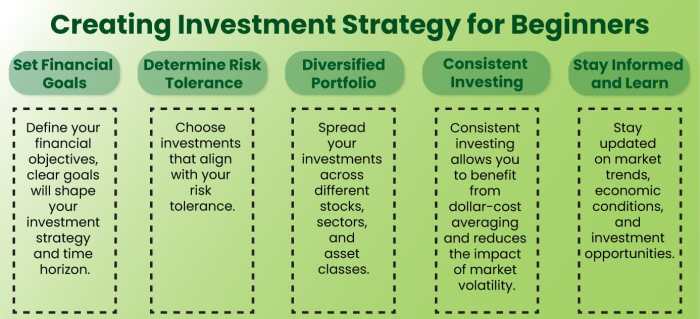
A diversified portfolio is the cornerstone of effective risk management. Diversification spreads your investments across different asset classes (stocks, bonds, real estate, etc.) and sectors, reducing the impact of any single investment performing poorly. For beginners, a simple approach might involve investing in low-cost, diversified mutual funds or exchange-traded funds (ETFs) that track broad market indexes. This instantly diversifies your holdings across hundreds or even thousands of individual securities.Another crucial aspect is understanding your risk tolerance.
This refers to your ability and willingness to accept potential losses in pursuit of higher returns. Beginners should generally favor a more conservative approach, focusing on investments with lower risk and potentially lower returns. This might involve allocating a larger portion of your portfolio to bonds or lower-volatility stocks. Avoid investing money you cannot afford to lose.
Monitoring Investment Performance
Regularly tracking your investment performance is essential to ensure your strategy remains on track. Most brokerage accounts provide online tools to monitor your portfolio’s value, returns, and overall performance against benchmarks. Pay attention to your portfolio’s overall return, as well as the performance of individual investments. This allows you to identify underperforming assets and potentially adjust your allocation.For example, if you notice a specific sector consistently underperforming, you might consider reducing your exposure to that sector.
Conversely, if a particular investment is significantly outperforming your expectations, you may consider increasing your allocation, but always keeping diversification in mind. Compare your portfolio’s performance to relevant benchmarks, such as a broad market index (like the S&P 500), to understand how your investments are performing relative to the overall market.
Regular Portfolio Review and Rebalancing
A step-by-step guide to regularly reviewing and rebalancing your investment portfolio:
- Set a Schedule: Establish a regular review schedule, such as quarterly or annually. Consistency is key.
- Assess Performance: Review your portfolio’s performance against your benchmarks and individual investment goals. Note any significant deviations from your expectations.
- Rebalance as Needed: If your portfolio has drifted significantly from your target asset allocation (e.g., due to some investments outperforming others), rebalance by selling some of the overperforming assets and buying more of the underperforming ones. This helps maintain your desired level of risk.
- Adjust Strategy: Based on your performance review and market conditions, consider making adjustments to your overall investment strategy. This might involve shifting your asset allocation, choosing different investments, or altering your risk tolerance.
- Document Changes: Keep detailed records of all transactions and adjustments made to your portfolio. This will help you track your progress and learn from your experiences.
For instance, if your initial target allocation was 60% stocks and 40% bonds, and over time your stock allocation increased to 70%, you would rebalance by selling some stocks and buying more bonds to restore the 60/40 ratio. This helps to maintain your desired level of risk and prevent overexposure to any single asset class. Remember that rebalancing isn’t about trying to time the market; it’s about maintaining your long-term investment strategy.
Resources and Further Learning
Embarking on your investment journey requires continuous learning and access to reliable information. This section highlights key resources and strategies to enhance your financial literacy and navigate the investment landscape safely and effectively. Understanding where to find trustworthy information and how to identify credible advisors is crucial for long-term success.Many reputable organizations offer valuable financial education resources. These include government agencies focused on consumer protection and financial literacy, non-profit organizations dedicated to financial education, and established educational institutions with robust financial programs.
These sources often provide unbiased information, educational materials, and tools to help you build a strong financial foundation.
Identifying Credible Financial Advisors
Choosing a financial advisor requires careful consideration. Look for advisors with relevant professional certifications and a proven track record. Check their credentials with regulatory bodies to verify their licensing and ensure they are in good standing. A reputable advisor will prioritize your financial goals and provide transparent, fee-based services, openly discussing their compensation structure. Be wary of advisors who promise unrealistic returns or pressure you into making quick decisions.
Thoroughly research any advisor before entrusting them with your investments.
Recognizing Investment Scams
Investment scams often involve high-pressure tactics, promises of guaranteed high returns with minimal risk, and a lack of transparency. Legitimate investments always carry some degree of risk, and no investment guarantees a specific return. Scammers may use sophisticated techniques to appear legitimate, so it’s crucial to independently verify any investment opportunity before committing funds. Consult with a trusted financial advisor or regulatory authority if you have any doubts about the legitimacy of an investment.
Characteristics of a Well-Structured Financial Literacy Program
A comprehensive financial literacy program for beginners should cover a range of topics, including budgeting, saving, debt management, and investing. It should use clear, concise language, avoiding complex financial jargon. Interactive elements, such as case studies, simulations, and real-world examples, can significantly enhance learning and understanding. The program should also provide access to ongoing support and resources, allowing individuals to continue their learning journey beyond the initial program completion.
A well-structured program empowers individuals to make informed financial decisions throughout their lives.
Successfully navigating the world of investing requires a blend of knowledge, discipline, and a long-term perspective. By understanding basic investment principles, diversifying your portfolio, and consistently monitoring your progress, you can confidently build wealth and secure your financial future. Remember, starting small and learning consistently is key to long-term success. This guide provides the foundational knowledge to begin your journey toward financial independence.
Query Resolution
How much money do I need to start investing?
Many investment platforms allow you to start with relatively small amounts, even a few hundred dollars. The key is to begin consistently, even with small contributions.
What is the best investment for beginners?
There’s no single “best” investment. The ideal choice depends on your risk tolerance, financial goals, and time horizon. Diversification across different asset classes is generally recommended.
How often should I review my investment portfolio?
Regularly reviewing your portfolio, at least annually, allows you to monitor performance, rebalance as needed, and adapt to changing circumstances.
What are the risks involved in investing?
All investments carry some degree of risk, from the potential loss of principal to fluctuations in market value. Understanding these risks and diversifying your portfolio can help mitigate potential losses.


